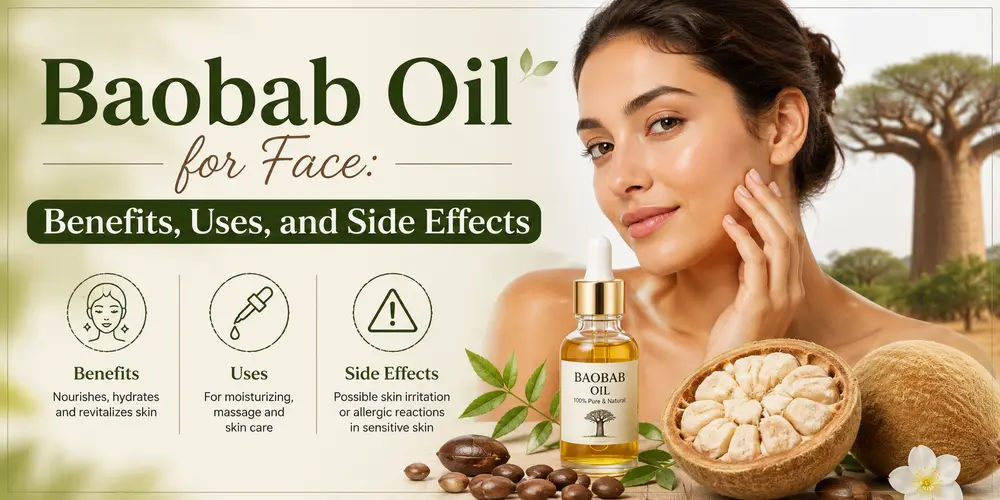
There’s a reason baobab oil is quietly showing up everywhere in skincare circles, like in those long chats between formulators and beauty people, you know. It’s pressed from the seeds of the old baobab tree, a species native to Africa and Madagascar, that can actually live for ages, like thousands of years— and inside it you’ll find vitamins, fatty acids, plus antioxidants that make it a real powerhouse for facial skin. It feels light, absorbs fast, and is gentle enough for almost all skin types, so yeah, it’s getting a permanent spot in a lot of routines. And if your routine already includes other natural must-haves, then this is a good moment to Buy Neem Oil Online too, because the two pair up really well for that more steady, botanical approach to skincare. In this guide, we’ll go through the basics of baobab oil for face, its benefits, the best ways to use it, and a few small precautions so you don’t miss anything important.
Baobab oil comes from the seed kernels of the baobab tree, often called the “Tree of Life” for its ability to survive extreme drought and still stay alive for centuries. The extraction is pretty straightforward, seeds are cold-pressed, with no added heat or weird chemicals, so the natural nutrient profile stays intact. What you get is a golden-yellow oil full of vitamins A, D, E, and essential fatty acids such as omega 3, 6, and 9. Compared to heavier carrier oils, baobab oil is noticeably thin and silky. It sinks in quickly, without leaving that greasy layer, which is part of why it’s popular in facial serums, moisturizers, and night oils. You can Buy Baobab Oil Online from reputable botanical oil suppliers, ideally ones that offer authentic products and share clear sourcing information
natural skincare lineup— many folks who love baobab oil also Order Baobab Oil online, together with other plant-based staples, for both morning and evening routines.
Baobab oil is usually well tolerated, but since it’s still a new ingredient for many people, a few precautions really do help:
If you’re searching for a trusted Baobab Oil Supplier, it’s worth taking the time to compare sourcing practices, extraction methods, and third-party testing before you commit to any brand.
Honestly, Baobab oil kind of earns its reputation as a skincare staple— it hydrates, without that heavy, sticky feeling, it helps the skin look more balanced and even, and it seems to support a firmer feel over time. Also, it just blends kind of nicely into most routines, even if you’re not really the type who loves facial oils. If you’re totally new to this whole thing, or you’re trying to switch up what you use now, Baobab oil is a pretty flexible addition, worth checking out. If you’re ready to feel those benefits yourself, you can find Baobab Oil for sale through reputable natural skincare suppliers, and it’s usually easy to locate a source that matches both your routine and budget. And if you’re trying to go for high quality botanical oils with an ethical focus, purestbotanical.com is a good starting point for exploring
1. What is Baobab Oil?
Baobab oil is a natural oil made by extracting the seeds from the baobab tree. It tends to be rich in vitamins, antioxidants and essential fatty acids, so it can nourish the skin, and moisturize.
2. Is Baobab Oil good for the face?
Yeah. Baobab oil helps with hydration, supports elasticity, reinforces the skin barrier, and may reduce the look of fine lines and dryness.
3. Can I use Baobab Oil every day?
Yes, for most people it can be used daily either in the morning, or in the evening. Obviously, it’s best if it actually suits your skin type and how your skin responds
4. Are there any side effects of Baobab Oil?
Side effects are pretty uncommon, though some sensitive people may notice mild irritation, or allergic reactions. It’s a good idea to do a patch test before you use it the first time, just to be safe
5. How do I choose the best Baobab Oil Supplier?
Pick a supplier that provides 100% pure, cold-pressed, unrefined baobab oil, with clear ingredient details. Also look for quality testing you can genuinely verify
6. Where can I Buy Baobab Oil Online?
You can Buy Baobab Oil Online from reputable botanical oil suppliers, ideally ones that offer authentic products and share clear sourcing information
7. Can Baobab Oil be used with other natural oils?
Yes. Baobab oil pairs well alongside oils like coconut oil, or neem oil, and you can mix them to create a more personal skincare or haircare routine, depending on what you’re trying to do
8. How should Baobab Oil be stored?
Store baobab oil somewhere cool and dry, away from direct sunlight. Keep the bottle tightly sealed, so the quality and freshness stays as stable as possible